Introduction to the Use case and its relationship with SusFE
Today, wound monitoring largely relies on clinical observation. Healthcare professionals assess the evolution of a wound primarily through visual inspection and sometimes olfactory cues to detect potential infection or complications in the healing process.
This approach remains relatively subjective and often requires patients to return to healthcare facilities for evaluation. As healthcare systems increasingly move toward ambulatory care and home-based treatment, there is a growing need for more objective and continuous monitoring methods.
Providing healthcare professionals with measurable data could significantly improve wound management and enable earlier detection of complications.
An intelligent wound monitoring system could support the growing shift toward outpatient care by:
- Enabling better remote monitoring of patients
- Providing early alerts in case of potential infection
- Reducing unnecessary clinical visits
- Allowing faster medical intervention when needed
Such systems could improve both the efficiency of healthcare delivery and the quality of patient care. The SusFE programme has provided essential support for exploring this application area, enabling BeFC to investigate the integration of bioenzymatic energy harvesting into connected medical devices.
2. Progress made until publication and how the SusFE project has supported this work
A functional demonstrator has been assembled to measure and transmit environmental data via Bluetooth Low Energy (BLE) and Near Field Communication (NFC). The system can operate under ambient conditions, including ambient temperatures up to approximately 35 °C and relative humidity levels from 15 to 85%.
The device currently achieves an operational lifetime of around five days, which aligns with typical wound care practices where dressings are changed every two to three days.
This demonstrator validates the feasibility of integrating low-power sensing and wireless communication within a compact system powered by a bioenzymatic metal-free energy source, demonstrating its potential for smart wound monitoring applications.
The SusFE project has been instrumental in enabling this progress. Through its support, BeFC has been able to:
- Develop and validate a first-generation functional prototype
- Characterise the performance envelope of bioenzymatic fuel cells under wound-relevant conditions
- Demonstrate viable wireless data transmission powered solely by enzymatic energy harvesting
- Establish baseline operational metrics for further clinical development
The results obtained to date represent a significant step toward a fully self-powered, metal-free wireless sensing platform for wound care monitoring applications.
3. Sustainability aspects of the solution
The use of BeFC® proprietary Bioenzymatic Fuel Cells solution as a power source eliminates the need for conventional batteries. This is particularly relevant for medical applications such as smart wound dressings.
In many healthcare settings, used medical dressings and disposable devices are treated as medical waste and are typically incinerated after use. Conventional batteries containing metals or hazardous materials can complicate waste management and raise safety concerns during disposal.
A metal-free Bioenzymatic energy source offers a safer alternative for disposable medical devices, as it avoids the presence of lithium or other hazardous battery components. This approach simplifies end-of-life handling and aligns better with the disposal practices commonly used for medical consumables.
Key Sustainability Advantages
- Zero metal content eliminates hazardous battery components entirely
- Reduced ecological impact compared to conventional lithium-ion or alkaline batteries
- Compatibility with existing medical waste incineration streams
- Developed and manufactured in France, reducing supply chain footprint
- Alignment with the growing regulatory push for sustainable medical device design
These characteristics position the BeFC technology as a compelling option for the next generation of disposable connected medical devices, where sustainability and patient safety are both critical considerations.
4. Next steps on the use case, even beyond the SusFE project
The next stage of this use case will involve collaboration with medical experts in order to validate the concept in a clinical context. Engaging with healthcare professionals will help assess the practical relevance of the proposed monitoring approach and identify the most meaningful indicators for wound management.
These discussions will also support the development of a proof of concept under realistic medical conditions. In addition, further work will explore the integration of additional sensors or indicators that could provide valuable insights into the wound environment and improve the monitoring capabilities of the system.
This collaborative approach will help refine the solution and ensure that the technology addresses real clinical needs in wound care monitoring.
Planned Development Milestones
- Initiation of clinical partnerships with wound care specialists and hospital departments
- Definition of the most clinically relevant physiological parameters to monitor (e.g. temperature, pH, moisture, biomarkers of infection)
- Development of a second-generation proof of concept integrating additional sensing modalities
- Validation of the system under realistic wound care conditions in collaboration with healthcare companies and clinical partners
- Exploration of regulatory pathways for medical device certification
Beyond the SusFE project
BeFC aims to establish itself as a key enabler of sustainable, self-powered connected medical devices, contributing to the transformation of wound care management and remote patient monitoring at scale.
As part of this strategy, BeFC will engage in co-development with a medical OEM or device manufacturer, enabling efficient navigation of certification processes, execution of clinical trials, and successful market access through established commercialization channels in wound care segments.
5. Annexes
a. Smart Wound Monitoring with Bioenzymatic Fuel cell & activation reservoir
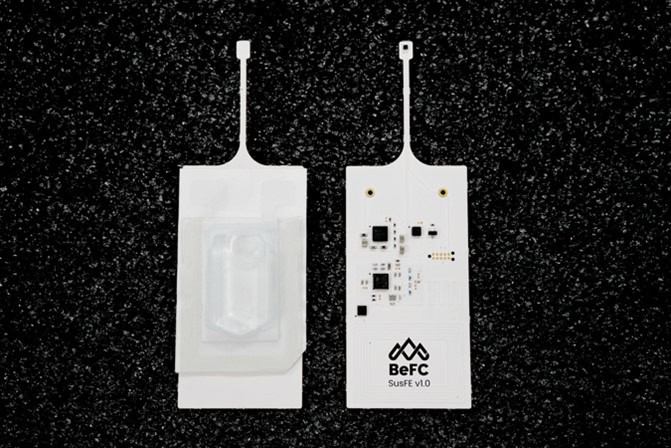
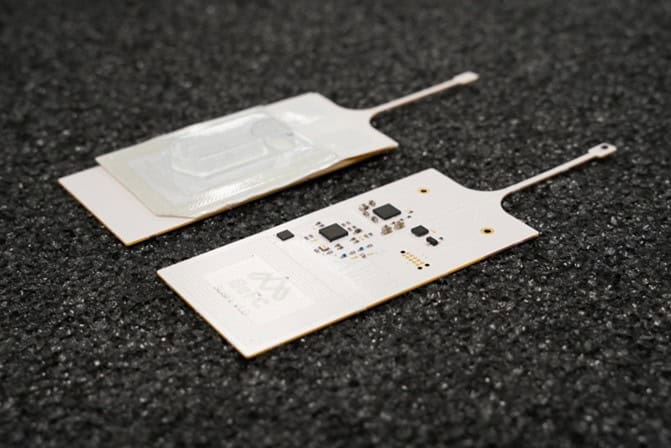
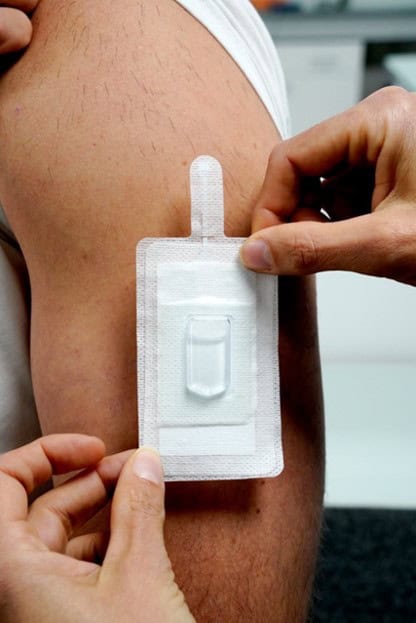
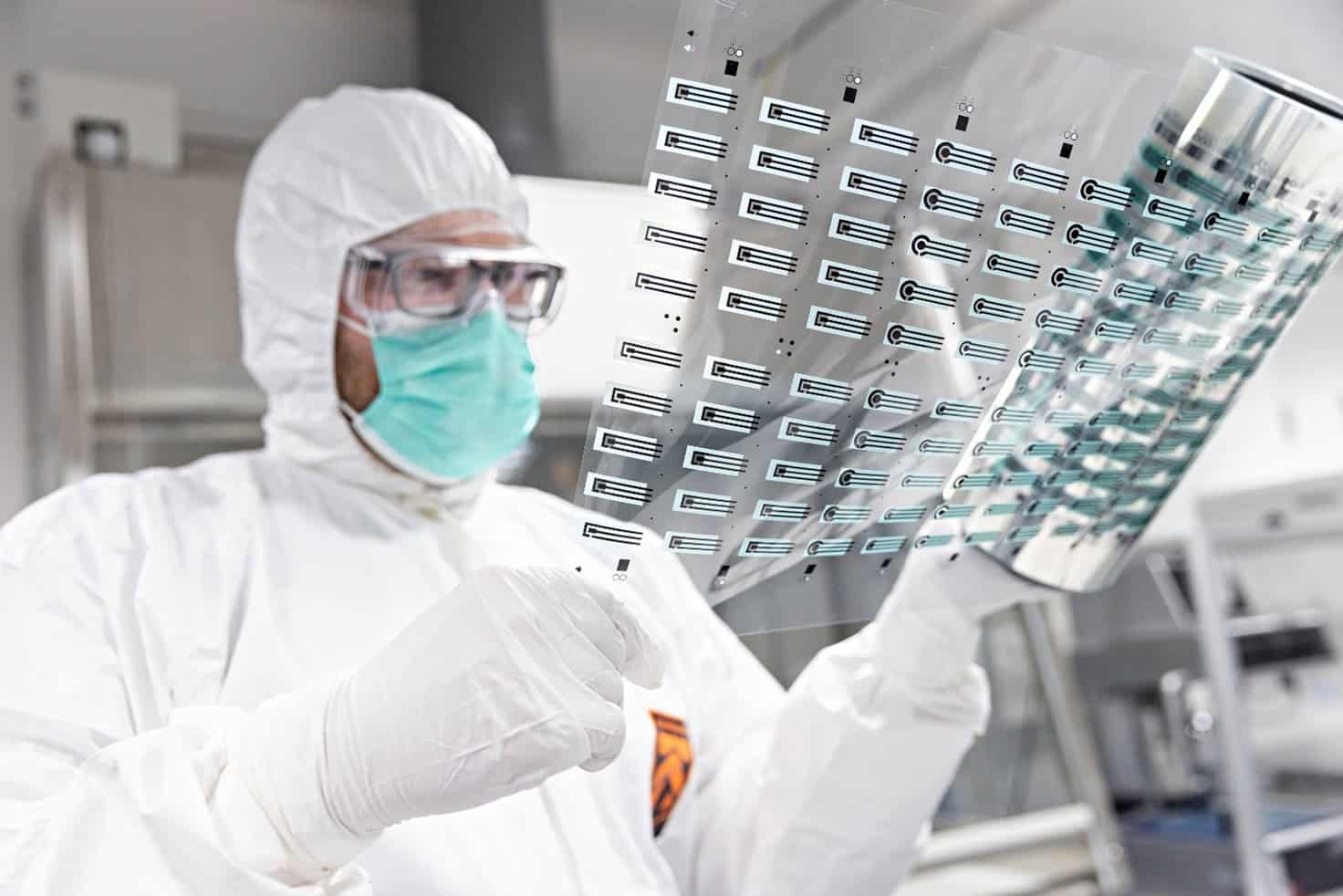
The demonstrator consists of a Bioenzymatic Fuel Cell as the energy source, combined with an electronic platform integrating sensors on a flexible PCB to ensure optimal skin conformity.
b. Smart Wound Monitoring with Medical-Grade Skin-Integrated Packaging
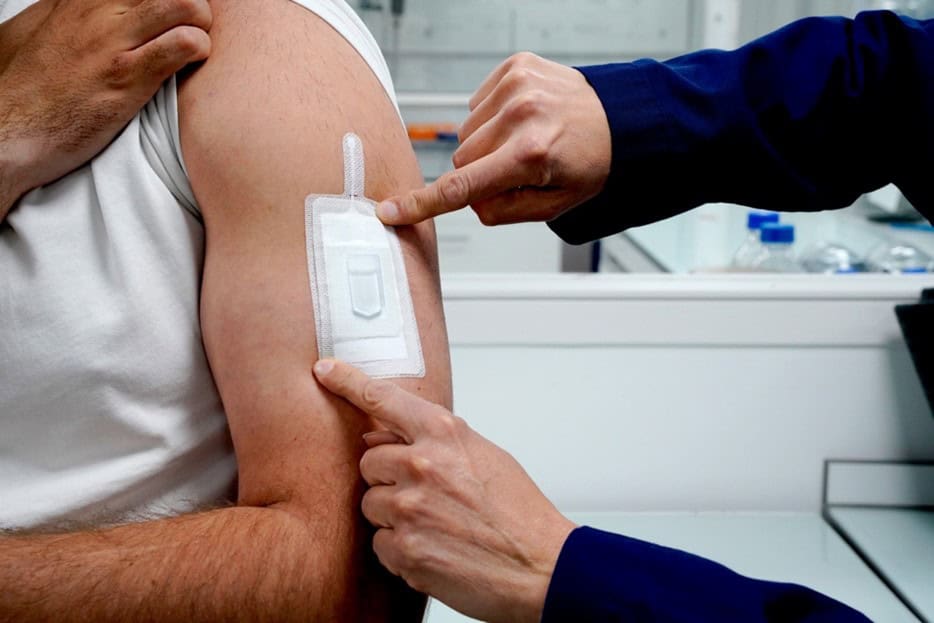
The smart wound patch is designed for on-skin application, integrating medical-grade packaging to ensure safe and effective contact with the patient’s skin. Functional testing is conducted directly on the skin, enabling continuous monitoring of temperature and other critical physiological parameters. Data is transmitted wirelessly via Bluetooth Low Energy (BLE) or can be accessed through Near Field Communication (NFC).